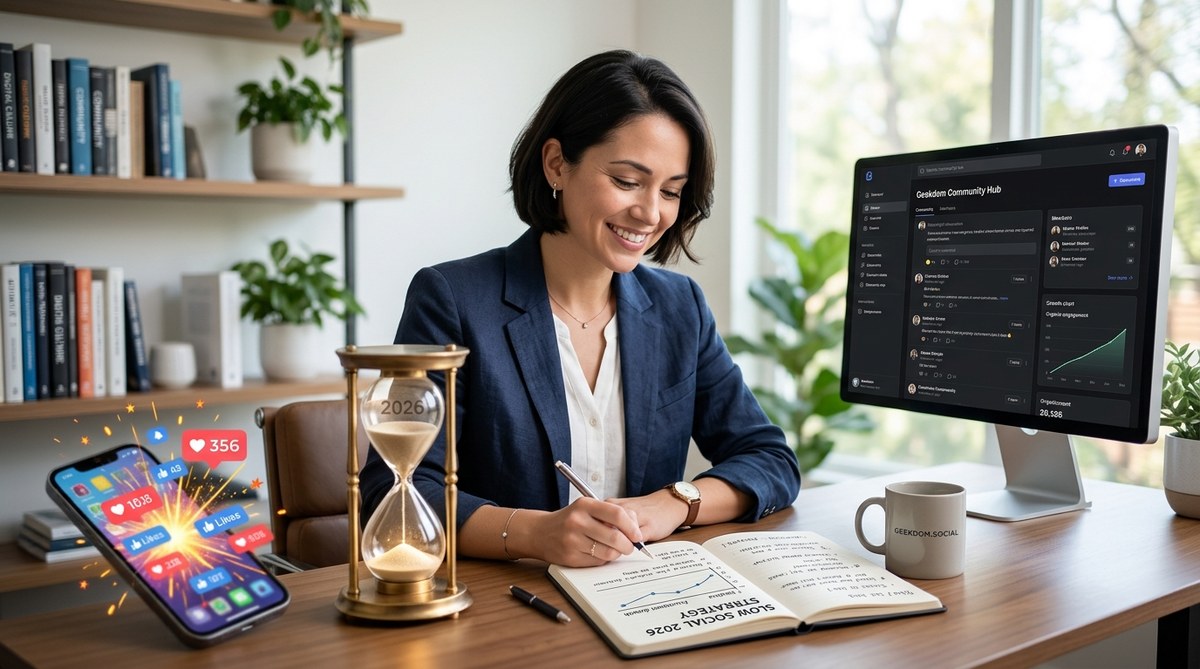
You are a digital marketer. You have been on the hamster wheel for years. Post three times a day. Hop on every trend. Chase the algorithm update. You are tired. The numbers go up, then they go down. The burnout is real. What if the secret weapon for 2026 was not doing more, but doing less? What if you slowed down?
A slow social media strategy for 2026 is not about laziness. It is about intentionality. By focusing on deep engagement, community building, and high-quality content over viral volume, you build a loyal audience that trusts you. This approach reduces burnout, improves long-term metrics, and creates a sustainable online presence that thrives even when algorithms change.
Why the Viral Treadmill Is Breaking Down
The math of viral content is brutal. You spend hours producing a Reel or a TikTok. It gets 50,000 views. Then it disappears. You get zero long-term followers. Zero meaningful conversations. Zero sales. The platform shows your next post to nobody because the algorithm already moved on.
This is not sustainable. For your mental health, for your budget, or for your brand.
The shift toward a slow social media strategy 2026 is already happening. Users are tired of the noise. They want to trust the accounts they follow. They want to feel like they belong to a micro-community, not a broadcast channel. Platforms are catching up. They are rewarding content that keeps people on the app longer, which means content that sparks conversation and connection, not just passive scrolling.
If you are ready to step off the treadmill, here is your blueprint.
The Core Principles of Slow Social
Before we get into tactics, let us set the foundation. A slow social strategy rests on three pillars:
- Intentionality over volume. Every post has a clear purpose. Does it educate? Does it connect? Does it invite a response? If not, do not post it.
- Depth over reach. You want 100 people who care deeply about your work, not 10,000 people who scroll past. Deep engagement signals to algorithms that your content matters.
- Sustainability over spikes. You can keep this pace for years. No burnout. No scrambling for trends at 11 PM on a Sunday.
A 3-Step Process to Build Your Slow Strategy
Ready to implement this? Follow these three steps to transition your workflow.
-
Audit your content with a fine-tooth comb. Go back through your last 30 posts. Separate them into three piles: posts that sparked real conversation (comments, DMs, shares), posts that got surface-level likes, and posts that flopped. Delete the flops from your mental library. Identify patterns in the winners. Was it a specific topic? A storytelling format? A call to action that asked a question? This is your starting data.
-
Reduce your posting frequency by half. If you post five times a week, drop to two or three. Use the extra time to engage in the comments of other accounts in your niche. Spend 15 minutes a day replying to every single person who commented on your last post. Answer DMs with thought, not with a canned response. This is the work that matters. For more on nurturing these relationships, check out our guide on building thriving online communities in the digital age.
-
Create one “pillar” piece of content per week. This is your anchor. A long-form video, a detailed carousel, a thoughtful newsletter excerpt. Everything else you post that week supports that pillar. You repurpose it into a quote graphic, a short clip, a text thread. You stop creating from scratch every single day. You create once, share thoughtfully.
The Table of Intent: What to Do vs. What to Stop
To make this shift concrete, here is a comparison of old habits versus new habits for your slow social media strategy 2026.
| Old Habit (The Viral Chase) | New Habit (Slow Social) |
|---|---|
| Post 5 times a day to “stay top of mind.” | Post 3 times a week with high intention. |
| React to every trend within 24 hours. | Observe trends and only join if they align with your core message. |
| Measure success by views and likes. | Measure success by thoughtful comments, saves, and shares. |
| Write captions for the algorithm (keywords and hashtags only). | Write captions for a human being (stories, questions, vulnerability). |
| Ignore comments after posting. | Treat the comment section as your primary channel. |
| Outsource content to AI without editing. | Use AI for brainstorming, but infuse every post with your personal voice. |
How to Spark Real Conversations (Not Just Noise)
The biggest mistake marketers make is treating social media like a billboard. You put a message out and hope people see it. Slow social treats it like a dinner party. You invite people in, you ask them questions, and you listen.
“The most powerful social media strategy is not a content calendar. It is a listening practice. When you understand what your audience is struggling with at 2 PM on a Tuesday, you do not need to guess what to post. You just answer their question.” — Anonymous community manager with 10 years of experience.
Start a weekly thread where you ask your audience one specific question. It could be about their biggest challenge in your industry. It could be a “this or that” about a product feature. Reply to every single answer. Do not just like the comment. Write a sentence back.
This builds a feedback loop. People start to expect that when they engage with you, they will get a real human response. That expectation is more valuable than any viral hit.
If you want to understand how these interactions shape larger trends, read about how online communities foster authentic engagement in the digital era.
Common Fears About Slowing Down (And Why They Are Wrong)
You might be thinking: “If I post less, I will lose followers.” Or: “My boss wants to see growth every month.”
Let us address those fears directly.
-
Fear: Less posting means less growth.
Reality: Algorithms now favor engagement rate over raw volume. If your two posts a week get 50 comments each, you will be shown to more people than if your seven posts a week get 5 comments each. Quality compounds. -
Fear: I will miss out on trends.
Reality: Most trends are irrelevant to your brand by design. The ones that matter will bubble up through your community. Your audience will tell you what they care about. You do not need to be first. You need to be right. -
Fear: My competitors are posting every day.
Reality: Let them burn out. While they are chasing the next dance move, you are building relationships that lead to sales, referrals, and loyalty. The tortoise wins this race every time.
For a deeper look at how platform changes support this approach, see how social media algorithms are changing user interaction in 2026.
Your Slow Social Starter Kit
Here is a checklist to get you started this week.
- [ ] Set a new posting schedule. Write it down. Stick to it.
- [ ] Delete any scheduling tool that encourages you to fill every slot.
- [ ] Write down your top 3 topics. Only post about those.
- [ ] Set a timer for 15 minutes of community engagement after each post.
- [ ] Turn off notifications for vanity metrics (like count).
- [ ] Create a single “pillar” piece of content for next Monday.
The Long Game Is the Only Game
The brands that win in 2026 will not be the loudest. They will be the most trusted. Trust is built slowly, one comment at a time, one helpful piece of advice at a time, one genuine interaction at a time.
You do not need to be everywhere. You need to be somewhere, fully present, for the people who matter most to your business.
Start small. Post less. Listen more. Watch what happens to your engagement, your energy, and your love for this work. You might find that the secret weapon was not a new tool or a hack. It was permission to slow down.