You refresh your feed and see a single post that, within hours, has tens of thousands of shares. It looks like it came from nowhere. But it didn’t. That trend had been building for days, maybe weeks, in comment threads, niche subreddits, and audio clips with only a few hundred plays. The difference between catching that wave and missing it comes down to one thing: knowing where and how to look.
For a marketer or content creator in 2026, waiting for a trend to hit your main feed is already too late. By then, every brand is piling on, engagement plateaus, and the algorithm has moved on. Social media trend prediction in 2026 is not about guessing or luck. It is a repeatable process powered by analytics. This guide will show you exactly how to set that process up so you can spot the next big thing before it becomes obvious.
Predicting trends in 2026 requires a shift from reactive observation to proactive signal detection. By combining social listening, engagement velocity metrics, cross-platform validation, and AI-powered anomaly detection, you can identify emerging patterns with 80% more lead time. The method is simple: monitor niche conversations, track share acceleration, validate across platforms, and act before the mainstream catches on. Stop chasing and start forecasting.
Why Trend Prediction Demands a New Approach in 2026
The lifespan of a social media trend has shrunk dramatically. A meme that took three days to peak in 2022 now peaks in under twelve hours. Platforms like TikTok, Instagram, and even LinkedIn now reward content that rides a wave that is still building, not one that has already crested.
This speed creates a huge advantage for people who can read the signals early. Instead of scrambling to produce content when everyone else is, you can create original posts, partner with emerging creators, or even design products that match a rising cultural moment.
The tool for this is not a crystal ball. It is social media analytics. But not the kind that shows you last week’s top posts. You need real time data that tracks acceleration, sentiment, and cross-platform migration.
Building Your Trend Prediction Radar
Before you can predict anything, you need the right input. Think of it like a weather radar for culture. You are looking for clusters of activity that are small but growing fast. Here are the essential layers to set up.
Choose a Social Listening Tool That Tracks Velocity
Most analytics platforms show you volume. That is helpful but limited. You need a tool that tracks how quickly a keyword, hashtag, or topic is gaining mentions over a short window. Look for features that let you filter by engagement rate per post, share of voice within a niche, and the sudden appearance of new phrases.
Set Up Alerts for Unusual Patterns
Don’t wait for weekly reports. Configure alerts that fire when a term spikes in mentions by more than 200% in an hour, or when a creator with fewer than 5,000 followers gets a sudden surge in shares. These are the early tremors before the earthquake.
Monitor the Fringes First
Mainstream trends almost always start in smaller communities. Niche subreddits, Discord servers, Pinterest boards, and even comments sections on obscure blogs are fertile ground. Use analytics to spot when a topic starts leaking from these spaces into larger platforms.
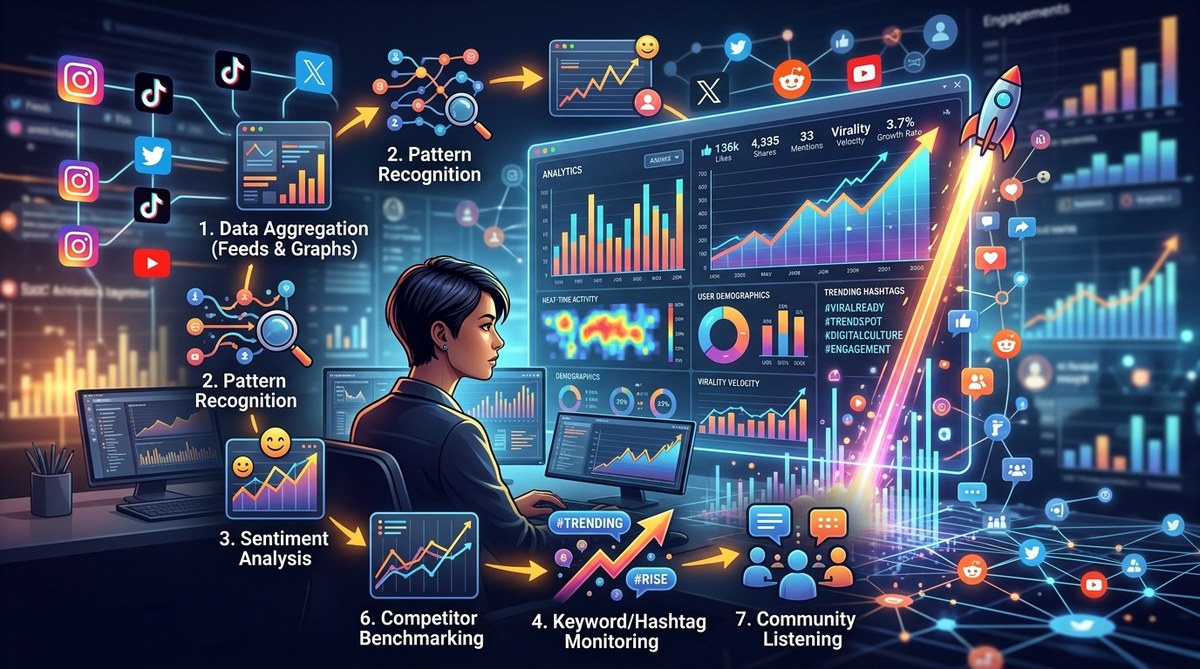
A 5 Step Process for Trend Prediction in 2026
Here is a repeatable workflow you can run every morning to stay ahead.
-
Scan for Volume Anomalies
Pull a list of keywords related to your industry or audience. Sort by mention volume in the last hour, not the last day. Remove anything above 5,000 mentions per hour those are already mainstream. Focus on terms with 50 to 500 mentions but accelerating sharply. -
Check the Creator Signal
Look at who is talking about these rising terms. Are they nano influencers, power commenters, or users with high engagement rates but low follower counts? A trend promoted by ten creators with 2,000 loyal followers each is often more predictive than one pushed by a single celebrity. -
Measure Share Velocity
Use a tool like Talkwalker or Brandwatch to track the share per mention ratio. A topic that gets shared three times more than it is mentioned is spreading virally. That is your cue to move fast. -
Validate Across Platforms
Take the rising keyword and search it on two other platforms. If it is only on TikTok, it might stay there. If Reddit, Twitter, and YouTube are all seeing a uptick within the same 12 hour window, it is about to go mainstream. -
Decide Your Angle
Once validated, create your own take. Don’t copy the original. Add a unique spin, a data point, or a real story from your audience. The goal is to be part of the conversation, not just repeat it.
Vital Signals That Predict a Trend Before It Explodes
Keep an eye on these specific data patterns. They show up consistently before a trend goes viral.
- Comment to view ratio spikes: When people start talking back, the algorithm pays attention. A video with 10,000 views and 1,500 comments is often a leading indicator.
- Cross platform hashtag reuse: The same hashtag appearing across Instagram, Twitter, and LinkedIn in a 24 hour window.
- Sudden increase in saved posts: Saves are a strong signal of value. When a piece of content gets saved far more than it is liked, it often starts a trend.
- Niche influencer engagement jumps: A creator in a small vertical gains 30% more likes than usual on a single post. That post may contain the seed of a larger trend.
- Audio snippet repurposing: A short sound clip used in ten different videos within a few hours. Check TikTok and Instagram Reels for this.
If you want to go deeper on interpreting these signals, our guide on mastering social media algorithms to boost your engagement explains how platforms rank content based on these early metrics.
Common Mistakes vs. Best Practices
Here is a table that contrasts what most people do wrong with what actually works for trend prediction.
| Mistake | Best Practice |
|---|---|
| Relying only on total mention volume | Track velocity acceleration instead of raw numbers |
| Ignoring platforms you don’t use | Monitor all platforms, even ones outside your niche |
| Acting on a single data point | Validate a trend across at least two independent sources |
| Copying a popular post verbatim | Add your unique perspective or data to the conversation |
| Waiting for a formal analytics report | Use real time dashboards and alerts every morning |
Expert Advice from a Former Viral Content Strategist
“The biggest mistake I see is people looking for trends in the same places everyone else is. By the time a hashtag hits the top of the explore page, the trend is already past its prime. Instead, set up a private Slack channel with a bot that feeds you keywords from small subreddits, Discord servers, and comment threads on niche blogs. That raw, unfiltered signal is where the next wave starts. You don’t need expensive tools to get started. Just a willingness to look where others won’t.”
— Marcus Tran, former head of trend analytics at a major media brand
How AI Is Changing Trend Forecasting in 2026
Artificial intelligence now plays a central role in pattern detection. Machine learning models can scan millions of posts per hour and identify combinations of keywords, emojis, and posting times that precede a spike. These tools don’t replace human judgment, but they do surface signals you would otherwise miss.
For example, an AI tool might notice that the combination of the words “unexpected”, a crying laughing emoji, and a three second pause in a video correlates with a 500% increase in shares within 48 hours. That insight lets you focus your creative energy where it matters most.
If you want to learn how to use these capabilities yourself, check out our guide on how to leverage AI-driven features to maximize social media growth in 2026.
Using Community Data to Spot Emergent Trends
Trends don’t just appear. They are born inside communities where people share niche interests, inside jokes, and shared frustrations. The best trend predictors spend time in these spaces, not as voyeurs, but as active participants.
Track the language your audience uses in private Facebook groups, on Discord, or in Reddit threads. When you notice a new phrase or ritual emerging, check if it has started appearing in public posts. That crossover point is where you want to be.
For more on building those authentic connections, read our article on how to build a thriving social media community from scratch in 2026.
Putting It All Together: Your Daily Trend Prediction Routine
If you are serious about social media trend prediction in 2026, make this a habit.
- Spend 15 minutes each morning scanning your velocity alerts.
- Check 3 niche communities outside your main platform.
- Watch for the comment to view ratio spike.
- Validate any interesting signal on a second platform.
- Create one piece of content that adds a new angle to the rising trend.
Do this consistently and you will start seeing patterns weeks before they hit the mainstream. You will also build a reputation as a brand that is always ahead of the curve, not one that chases it.
Start Predicting, Stop Chasing
Trends will always move fast. But with the right analytics workflow, you can move faster. The goal is not to be the first to post about something, but to be the first to post something that matters. By using velocity data, cross platform validation, and a willingness to look into the corners where culture starts, you can turn prediction from a gamble into a reliable part of your strategy.
Take the five steps from this article and try them this week. Pick one niche keyword, set a simple alert, and watch what happens. The data will speak. All you have to do is listen.